How well does an open ECG model travel?
I’m independently evaluating ECGFounder, an AI model built by another research team to analyse the heart’s electrical recordings.
I started by checking whether I could reproduce one of their published evaluations. Next, I’m preparing a fair comparison using their separately trained single-lead model and recordings taken during surgery.
This is the running record of that work: what I tried, what I found, and what I still need to understand.
- My role
- Independent evaluation of a released model.
- Starting point
- PTB-XL, one of the paper’s test datasets.
- Current focus
- Preparing the single-lead comparison.
Why look at the heart’s electrical signal?
An ECG records tiny electrical changes as the heart beats. The timing and shape of the trace help clinicians assess heart rate, rhythm and how electrical signals travel through the heart.
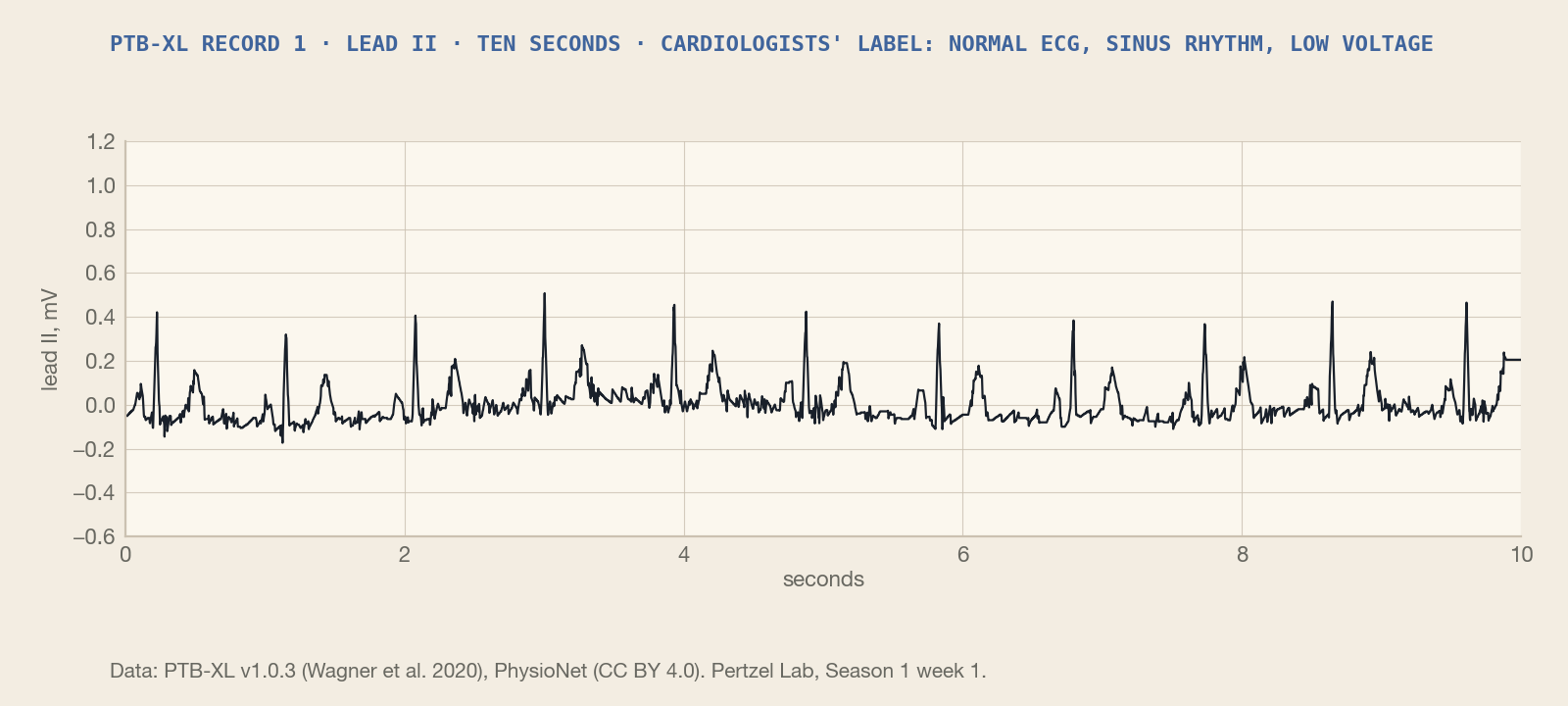
Data: PTB-XL v1.0.3, Wagner et al. (2020), PhysioNet, CC BY 4.0.
Recording source and licence ↗
View the full 12-lead input recording
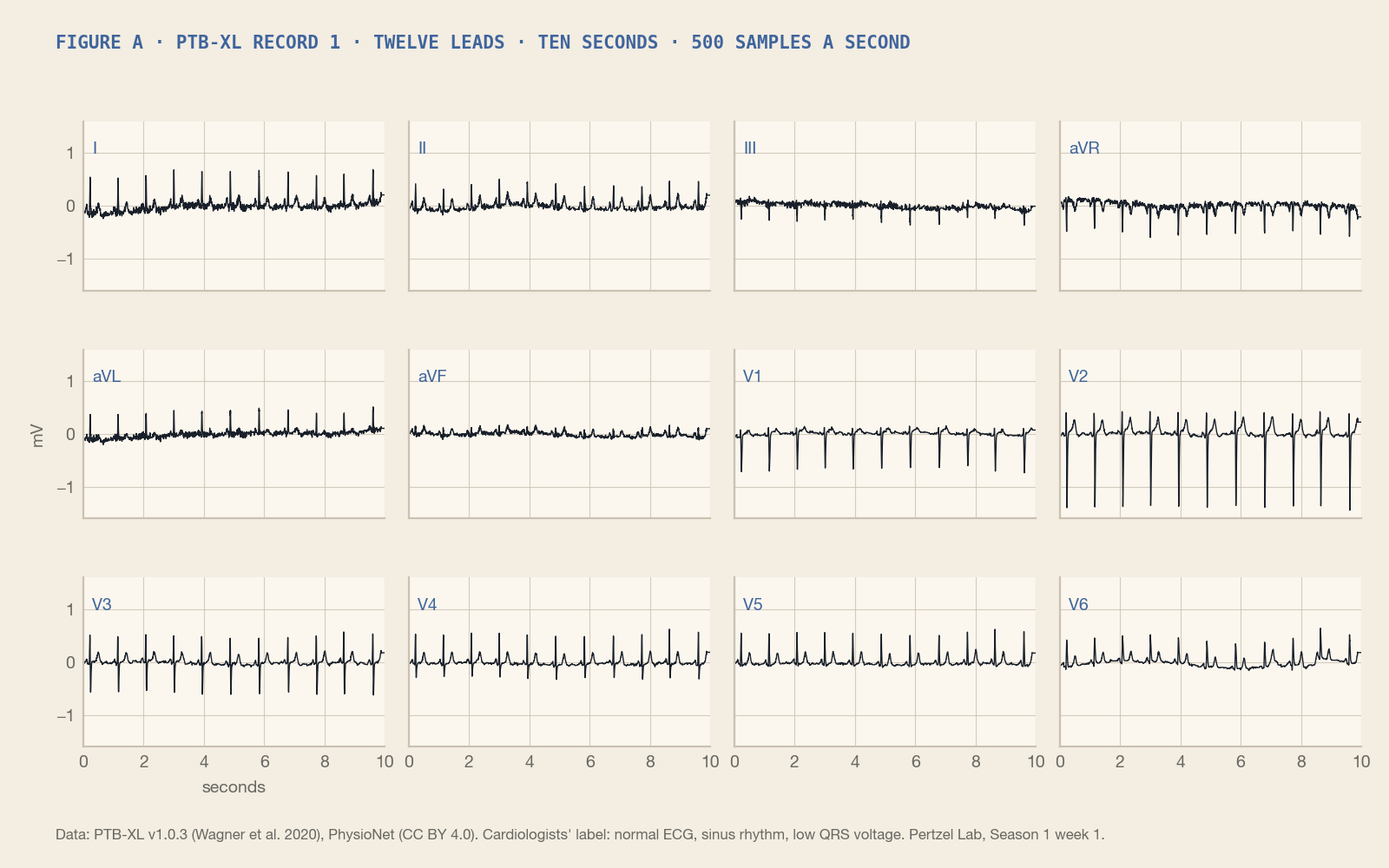 PTB-XL record 1 · All twelve simultaneous ten-second signals · 500 samples/second · Wagner et al. (2020), CC BY 4.0.
Researchers are also studying subtler patterns linked to wider health. The ECGFounder paper explores kidney disease using extra training for that task. That possibility interests me; it is not something this lab has demonstrated. Study methods ↗
How do the leads connect?
An electrode is a contact on the skin. A lead is an electrical view made by comparing voltages. The AI model is separate software that reads the resulting recording.
12-lead ECG
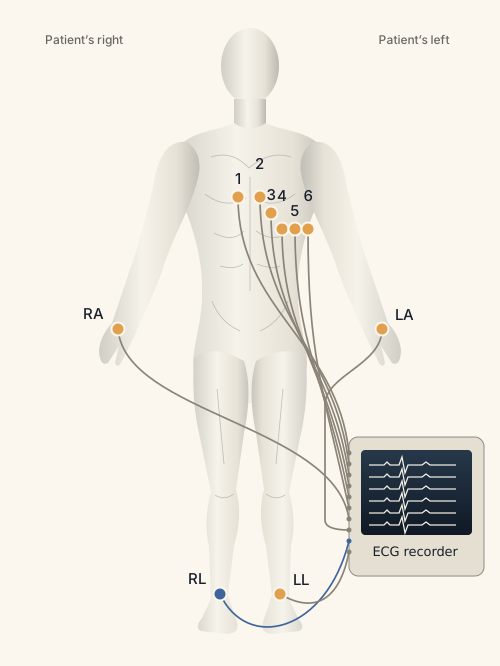
Nine measurement contacts: six on the chest and three on the limbs. Their signals combine into twelve views.
Single-lead ECG
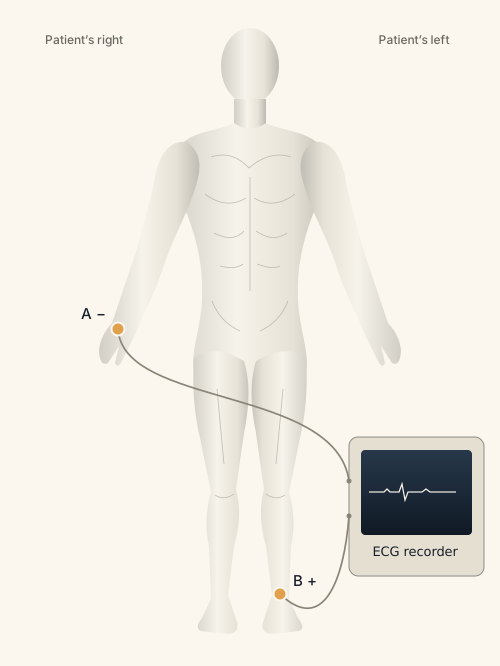
Both contacts measure. The recorder subtracts the voltage at A from B to produce one lead trace. A third contact for interference is omitted here.
Educational schematic: contact positions are approximate and recorder traces illustrative. A standard twelve-lead ECG uses ten skin contacts, including a right-leg contact that supports interference reduction. This single-lead example shows only the two measurement contacts; a separate third contact may reduce interference. It is not a device setup guide.
What the researchers built. What I’m checking.
ECGFounder is the authors’ AI model; PTB-XL is a public collection of ECGs with reference labels; my work is an independent evaluation. The paper already used PTB-XL. I did not train the model.
The paper includes twelve-lead and separately trained single-lead models. This season starts with the twelve-lead reproduction. A matched PTB-XL lead-II baseline using the single-lead model is planned before the VitalDB comparison.
I’m checking how closely the released model reproduces the published evaluation, and how choices in preparing the ECG change the scores. Before comparing datasets, I also need a matched single-lead baseline so that a change of model is not confused with a change of recordings.
That is an evaluation of the model’s behaviour. It does not establish a benefit for patients or show that the model is ready to use on a new device.
A project that develops week by week.
The journal keeps the dated experiments, findings and open questions together. The introduction stays focused on what the project is about.
Start with the original work.
The ECGFounder paper is the starting point for this project. My own evaluation and its limitations are documented in the weekly journal.